Kevin O'Leary's $500,000 Retirement Rule, Checked Against the Numbers
O'Leary says $500,000 can fund a retirement if you live on the income and never touch the principal. Here is what that actually pays, how it compares to a real safe withdrawal rate, and what the flat number leaves out.

Working out whether a retirement number is actually enough is one of the harder judgments in personal finance. Kevin O'Leary's version is a flat rule rather than a calculation: hold $500,000, invest it to earn around 5% a year, spend the income, and leave the $500,000 itself untouched. The appeal is obvious. One sentence, a number well below the seven-figure targets usually quoted, and a moment when 5% is genuinely available without reaching for risk.
On the other hand, a rule that fits in one sentence is easy to mistake for a complete plan. It says nothing about tax, inflation or healthcare. Treated as a starting number it earns its popularity. Treated as the whole answer, it hides most of the work.
Here is what the $500,000 actually produces, how that compares to how retirement research answers the same question, and what the flat number leaves for you to work out.
What the rule actually says
$500,000 earning close to 5% a year produces about $25,000 in annual income, roughly $2,083 a month, before tax. The discipline is the rule: spend the $25,000, leave the $500,000 invested, and the portfolio can in theory keep paying out indefinitely, closer to how an endowment runs than how most people draw down a retirement account.
That 5% used to be the weak point. For most of the decade before rates rose, earning it from safe fixed income meant taking on real risk. That has changed: the US 30-year Treasury has recently yielded above 5.2%, so a retiree can get close to O'Leary's number from government bonds alone. The trade-off is duration: lock in a rate that long and the payment stops adjusting for inflation on its own.
Why the real number is smaller
A yield and a safe withdrawal rate sound like the same question and are not. A yield is what a portfolio currently produces. A safe withdrawal rate asks whether that spending survives a full retirement, weak markets and inflation included.
Morningstar's 2026 base case, for a new retiree on a 30-year horizon with 30% to 50% in equities, puts the sustainable first-year withdrawal at 3.9%. On $500,000, that is about $19,500, roughly $5,500 below O'Leary's figure. The gap is not really about returns. O'Leary's rule avoids the drawdown question because the principal is never meant to be spent; Morningstar's number is built for a portfolio allowed to shrink as long as it lasts the full retirement.
The risk a flat percentage hides
An average return over thirty years does not guarantee spending at that average rate, because the order returns arrive in matters as much as the average. A sharp decline early in retirement forces withdrawals from an already-smaller balance, leaving less capital to recover later.
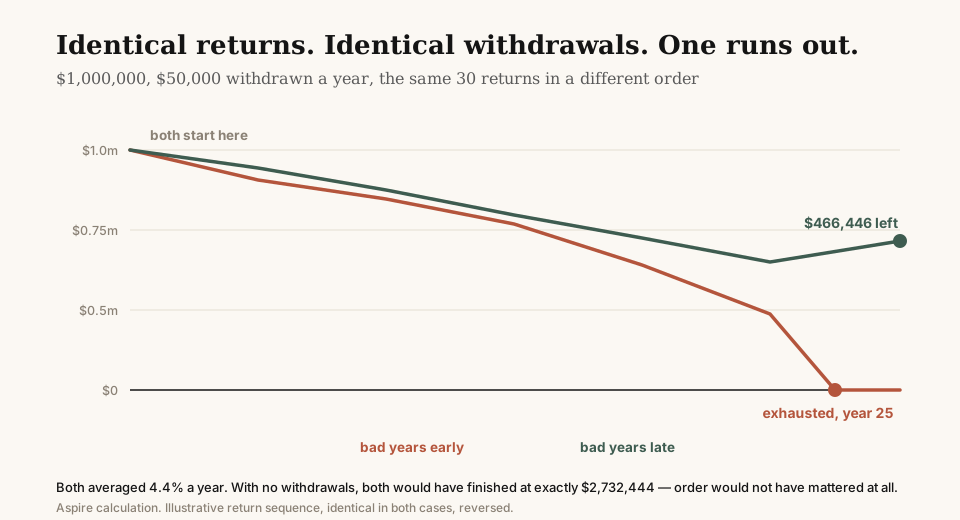
Both retirees above average 4.4% a year and withdraw the same $50,000 annually. Only the order of the bad years differs. It is why sustainable withdrawal rates tend to peak around a moderate equity allocation rather than rising every time the stock share does: more equity raises the long-run average and raises the damage a bad early sequence can do, together.
What the flat number leaves out
1. Tax reduces what actually lands in your account. Interest in a taxable account is generally taxed as ordinary income, and Social Security can become partly taxable too. The $25,000 is a pre-tax figure.
2. Inflation erodes a fixed payment every year it continues. At 2.8% average inflation, $25,000 received twenty years out buys about what $14,400 buys today. A rule built purely on preserving capital has no answer to this, because the income was never designed to grow.
3. Healthcare and longevity extend the first two problems. Costs tend to rise later in retirement, exactly when a fixed income has already lost the most purchasing power.
4. It overlaps with Social Security more than it replaces it. The average retired-worker benefit was $2,085.98 a month in July 2026, close to what $500,000 produces here. Standing alone, with nothing else behind it, $500,000 carries a much heavier load.
Where this leaves you
O'Leary's number works best as a floor: a second income stream beside Social Security or a pension, with the preservation discipline held loosely enough to flex after a strong year and pull back after a weak one. Held rigidly and alone, the same $500,000 has to absorb tax, inflation and healthcare costs the one-sentence version never mentions.
The more durable part of what O'Leary teaches is the habit that gets someone there, not the $500,000 itself: $100,000 saved by the early thirties, given a couple of decades of growth, compounds into $500,000 or more, built on consistently saving somewhere around 15% to 20% of income. That habit matters whether the eventual number is $500,000 or several times it.
FAQ
Is Kevin O'Leary's $500,000 rule actually enough to retire on? On its own, about $25,000 a year before tax, a modest income by itself. Stacked with Social Security or a pension, it functions closer to a full plan.
Why is Morningstar's safe withdrawal rate lower than O'Leary's 5%? They answer different questions. O'Leary's number is a current yield. Morningstar's 3.9% base case for 2026 is a withdrawal rate built to survive a full 30-year retirement.
Can I actually get 5% safely right now? Long-dated US Treasuries have recently yielded above 5%, so the return is realistic. The trade-off is duration and a fixed payment that does not rise with inflation on its own.
Not investment, tax or retirement advice. Withdrawal rates, yields and tax treatment change with market conditions and personal circumstances; a retirement plan built on any single rule of thumb should be checked against your own numbers, ideally with a licensed advisor.